Thursday, February 6, 2014

Colonial Era Macroeconomics of Agriculture: Sugarcane

Sugarcane crop

Plantation


Sugar Trade in the eyes of Mark Johnston
"Soon after Columbus returned from his first voyage to the new world it became apparent to old world investors and the Spanish crown that the new territories could not be exploited as had been hoped. Indeed, Magellan’s circumnavigation of 1519-1522 proved that the territories visited by Columbus weren’t even parts of Asia, but a continent that could offer little in the way of spices and manufactured goods such as were exported from east Asia. However, the Europeans quickly realized that the new world possessed potential of a different sort: the production of sugar cane. Consequently, the plantation system and the sugar refining industry, rather than the harvesting of spices and silk production, were destined to shape the economy and society of Brazil and the West Indies.
The European discovery and colonization of Madeira and the Canary Islands would prove fateful precedents for the new world, because the plantation system and colonial governments instituted on these islands became models for the great sugar plantations in the new world.2 Since sugar cane had been introduced to Madeira and the Canaries after their colonization during the last half of the fifteenth century, the techniques of sugar production, exploitation of labor, and economic organization developed on these islands were easily exported to the new world.3 Ultimately, the adoption of these production techniques and the system of colonial government from the Atlantic islands, with the institution of slavery, made sugar production the most profitable cultivation in either the Americas or Europe.
The earliest large-scale production of sugar was established in Brazil, along the Atlantic coasts surrounding Bahia and Pernambuco. Although sugar cane was reputedly first planted in Brazil in 1516, it was apparently done as much for strategic as economic reasons, because the European powers were struggling for legal and economic claims to territory in the Americas.5 For the next four decades, trade with Brazil centered around the harvest of dyewood, since the demand and prices for sugar had slumped in Europe.But, by the sixteenth century, both demand and prices had risen because refined sugar was replacing honey in most recipes and was increasingly used as a sweetener in jams, jellies and other popular food products. The first commercial production of sugar in the new world was undertaken in 1550, when the Portuguese Donatarios built mills near Pernambuco and São Vicente along the Atlantic coast of Brazil.7 This early production was derived principally from techniques developed in Madeira, based upon a system resembling sharecropping, where the owner, or senhor de engenho, leased his land to a number of smaller planters in return for a portion of the sugar produced.
By the middle of the seventeenth century the Brazilian sugar industry had begun to expand rapidly with support of capital from the Dutch East India Company, which had seized Pernambuco from the Portuguese in 1630, and the Dutch importation of slaves from equatorial Africa. In 1612 the total production of sugar in Brazil had reached 14,000 tons, and by the 1640s Pernambuco alone exported more than 24,000 tons of sugar annually to Amsterdam.
However, the 1660 the focus of sugar production began to shift from Brazil to Barbados and other islands of the West Indies. Unfortunately, this process is not well understood, primarily due to a lack of documentation. It has been suggested that Brazil suffered from economic stagnation because of higher production costs, decreasing yields and general trends in investment that negatively affected sugar production. Furthermore, the expulsion of the Dutch from Pernambuco in 1654 and the subsequent disruption in trade led the Dutch to focus their capital investments in the West Indies.
Surviving evidence shows that despite increases in production, Brazil was not able to keep the sugar refineries in Amsterdam adequately supplied, forcing the Dutch refiners to look elsewhere for the product.Barbados, which had been developing the sugar industry under the leadership of the Englishman John Drax, proved to be a perfect complement. Drax, who had been a student of Portuguese and Dutch production methods and organization in Pernambuco, adapted sugar production to the limited resources of the islands and proved that, despite their relatively small size, the West Indies were capable of producing significant amounts of muscovado, or raw sugar. His adaptations included the abandonment of the Pernambuco model, which had called for self-sufficient plantations, as the limited timber resources and food production on the islands made such a system impractical.
Once established on the Caribbean island, sugar production increased rapidly, with Barbados experiencing an increase from 7,000 to 12,000 tons produced per year between 1655 and 1700. Even more remarkable is Guadeloupe, which increased its exports from 2,000 tons in 1674 to 10,000 tons in the early eighteenth century, with assistance from Martinique. 
Although Brazil remained the largest exporter of sugar, it was no longer dominant in the face of Dutch, and later French and English, competition from the Caribbean. The Dutch, French and English ultimately proved better able to endure the steadily decreasing prices resulting from the rapid rise in supply due to the geographical advantages of their proximity to Europe and the slave trade and their royal support in the form of official trade monopolies. However, the legacy of Brazil in the sugar trade remained significant, as the Portuguese and Dutch pioneered the plantation system from old world examples and adapted it to the special conditions of the new world. More importantly, this legacy is evident in the development of colonial society in the America. The plantation system of Brazil and the Caribbean, like the hacienda system on the continent, would endure for centuries as the model for agricultural production and rural society. The introduction of slavery would likewise leave a significant, most unfortunate legacy in the new world. Ultimately, sugar production provided one of the original means and motivations for European expansion, colonization and control in the new world, precipitating a course of events that would forever shape the destiny of the Western Hemisphere." --Mark Johnston


Colonial Era Macroeconomics of Agriculture: Tobacco

Tobacco Advertisement


Tobacco Plant


Tobacco Quotes

There is an herb called uppowoc, which sows itself. In the West Indies it has several names, according to the different places where it grows and is used, but the Spaniards generally call it tobacco. Its leaves are dried, made into powder, and then smoked by being sucked through clay pipes into the stomach and head. The fumes purge superfluous phlegm and gross humors from the body by opening all the pores and passages. Thus its use not only preserves the body, but if there are any obstructions it breaks them up. By this means the natives keep in excellent health, without many of the grievous diseases which often afflict us in England.

– Thomas Hariot, A Brief and True Report of the New Found Land of Virginia (1588)

Smoking is a custom loathsome to the eye, hateful to the nose, harmful to the brain, dangerous to the lungs, and in the black, stinking fume thereof nearest resembling the horrible Stygian smoke of the pit that is bottomless.

– James I of England, A Counterblaste to Tobacco(1604)

Tobacco Trade

"When Sir Francis Drake returned to England from the New World he had with him two plants never before seen in Europe, namely the potato and tobacco. England’s reaction to the plants was echoed all through out Europe. The potato was seen as poisonous while tobacco was seen with wonder and amazement.1 In this essay, I will give the brief history of the development of the tobacco trade during the 15th, 16th, and 17th centuries and explain what steps Europeans took to control that trade from interlopers.
Tobacco was first introduced to Europeans in 1492 when Columbus landed in the Americas. Columbus wrote in his diary, on October 15th, 1492, that he observed an Indian sailing in a canoe with water, food, and tobacco leaves.2 Use of tobacco spread rapidly among the Spanish colonists and in 1531 its cultivation began in Santo Domingo. In 1526 Gonzalo Ferdandez de Oveido y Valdez noted that his fellow Spaniards were turned into drunks by tobacco. Bartolome de las Casas observed the following year that the colonists were developing a strong dependence on it and that it was hard to give up. 
During the 16th century, tobacco use spread throughout all of Europe. It arrived in France in 1556, in Portugal in 1558, in Spain in 1559, and in England in 1565. By 1571 it had spread to nearly all parts of Europe.4 Not only did its usage spread quickly but also it quickly came to be seen as a cure for many major illnesses.5 In 1595, Anthony Chute published Tobacco in which he argued that physicians were keeping tobacco’s use a secret because they feared it would put them out of business. 
The 17th century saw the organization of the tobacco trade and the implementation of new laws regulating the sale of tobacco. In 1614 Spain proclaimed Seville the tobacco capital of the world. All tobacco produced for sale in New Spain had to first go through Seville before moving on to the rest of Europe. France and England passed analogous laws. King James I of England was the first to tax tobacco while King Louis XIV was the first to make its distribution and sale a state run monopoly. Laws restricting the cultivation of tobacco to the Americas were passed during the second half of the 1600’s in an effort to insure a steady high quality supply. During this time period the Tionontati, an Indian tribe located in what is today south-eastern Canada, produced tobacco for sale in Europe and were known by the French as the tobacco people. 
Efforts at limiting the consumption of tobacco for medicinal purposes during the 17th century failed all over Europe. In Turkey one could be beheaded for smoking in public. In Russia and Austria one could be fined, jailed, or tortured and in England King James I (the same king who realized that taxing tobacco made lots of money for the government) wrote about tobacco’s horribly addictive properties and the terrible black soot that it left in one’s lungs. The Catholic Church even tried its hand at limiting the use of tobacco by proclaiming its everyday use to be sinful. Few people listened, as there were no biblical passages that talked about the evils of smoking or sniffing tobacco.8
Notwithstanding efforts designed to curb the use of tobacco, its use rose tremendously during the 17th century. In 1614 Jamestown colony sent its first shipment of tobacco to England. It was rather modest in size. 1624 saw 200,000 pounds sold to England while 1638 saw 3,000,000 pounds sold. During the 1680’s Jamestown was producing over 25,000,000 pounds of tobacco per year for sale in Europe." --Mike Davey


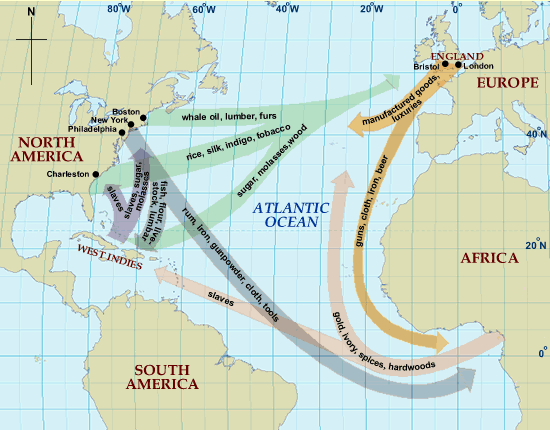
Mapping the world of trade

Trade routes
Triangle Trade 


Colonial Expansion


Tuesday, December 10, 2013

Heian Japan

Excerpt from "The llustrated Legends of the Kitano Shrine"
This is part of a larger series of paintings which tell the story of the origin of the Tenjin cult, a central part of Shintoism. Tis type of narrative painting is called Emaki.

Sculpture of Zao Gongen
This is a Shinto deity whose image was inspired by the Buddhist Gods of Brightness. His cult was Shugendo, which was devoted to mountain worship.


 Sculpture of Fudo Myoo
Fudo Myoo is the most prominent of the aformentioned Kings of Brightness, and was considered the defender of Buddhism, whose sword cut through ignorance. These two statues exemplify the intense religious competition that took place in Heian Japan.

Lotus Sutra
The Lotus Sutra gained popularity because it emphasized that the Buddha's compassion was open to all, which was enticing to women and the lower classes in Japan. The Lotus Sutra is stuctured in a way that is not at all dissimilar to an Emaki, using sequential illustrations as a method of storytelling.

Heart Sutra
The Heart Sutra's main tenet was that true wisdom comes from emptiness, the haloed figures surrounding the Buddha in both Sutras are Bodhisatvas. Interestingly, the technique is very similar to Song Woodblock techniques.


Wooden Figure of Fudo Myoo

Another King of Light, Fudo is the enemy of illusion, showing the true enlightenment beyond life and death. Fudo's sword is used to cut away illusions and expose reality.


A Battle between the Minamoto and Taira Clan

This massive screen serves to commemorate a critical battle between to warring clans, however it blends the events of two. The first two panels represent the battle of Yashima, and the last two panels represent the battle of Dannoura, which resulted in the final defeat of the Taira.

Battles of Ichinotani and Yashima
Here you can recognize the battle of Yashima from the first screen, but this portrayal was far after the fact, in the Edo period. The reason that this battle retained salience is that it was this conflict that resulted in Minamoto no Yoritomo become Japan's first Shogun.


Wooden statue of Kichijoten
Kichijoten's place in Heian culture is surprising, and this statue only makes it more so. Kichijoten is derived from Laksmi, wife of Vishnu and member of the Hindu Pantheon. Even more bizarrely, she is depicted here in Tang dynasty clothes. Her existence as a Japanese deity is strange given her outdated Chinese attire and hindu origin. Her gestures represent the overcoming of calamities and the granting of desires.


Ceremonial Jar
This ceremonial jar comes from Sanage, which gained prestige for there use of leftover ash as makeshift glazing. This was the closest Japan could come to the Chinese full glazing techniques. Ironically, it may have been a funerary jar.


Tale of Ganji
Handscroll paintings based on the famous novel of the same name, this is part of a larger collaborative work called Ganji-e, which told the story of Ganji in great detail through a series of different art pieces in different styles.

Mongolia

Mongolia


Panchen Lama by Zanabazar
http://www.mongolianculture.com/Mongolian-Traditional-Arts.htm
This is a depiction of an incarnation of the Panchen Lama by the acclaimed artist and eventual  Jebtsundamba Khutuktu Zanabazar. The Jebtsundamba Khutuku is the spiritual leader of Mongolian Buddhism. Zanabazar was considered to be the "Michelangelo of Asia"for his brilliant artwork, but "Da Vinci of Asia" might be more appropriate; he invented a new language which blended Mongolian, Sanskrit, and Tibetan; he even made significantg contributions to Astronomy and Medicine.


Thangka Depicting Zanabazar 
http://www.himalayanart.org/image.cfm/1089.html
this Thangka, or buddhist painting, is a representation of Zanabazar. This is interesting because Thangkas usually only depicted deities, showing the degree of veneration that Zanabazar had.


Portrait of Genghis Khan
 http://www.welcome2mongolia.com/archives/genghis-khans-portrait/
This is the only known portrait of Genghis Khan, made by Khorisun on the order of Kublai Khan.


Portrait of Kublai Khan
http://www.asianresearch.org/articles/2123.html
This is a portrait of Genghis's Grandson Kublai Khan, who ruled Yuan Dynasty China. This Portrait is also post mortem, made by Araniko, a nepalese artist who served in the Khan's court.


Buryat Dress Deels
http://www.interactivemongolia.com/clothes.html
This is an example of formal mongolian dress, which would be worn at times of political importance, such as political events.


Mongol Coin, minted in Samarkand.
http://www.britishmuseum.org/research/collection_online/collection_object_details.aspx?objectId=3315097&partId=1&searchText=mongol
Coins like these circulated throughout the silk roads, and consequentially through all of eurasia.


Ilkhanid Bowl 
http://www.britishmuseum.org/research/collection_online/collection_object_details.aspx?objectId=237075&partId=1&searchText=mongol&page=2
This bowl exemplifies the political and cultural fusion between the persians and mongols.


Sutra Holder
http://www.britishmuseum.org/research/collection_online/collection_object_details.aspx?objectId=227054&partId=1&searchText=mongol&page=2
This chest was made in Mongol occupied Korea at the behest of Kublai Khan's wife.

Ilkhanid tile
Another Example of cultural blending, this tile has traditional Mongolian hairstyles put persian poetry on the margins.


Yuan Dynasty Sculpture
The mongolian rule of China brought about many things, one of which was cultural mixing within the larger Mongolian Empire, this statue exhibits significant Nepalese influence.


Friday, September 27, 2013

Maya: Those Who Did Not Create The Shwedagon Paya


Statue of The Maize God
The Maize God, Hun Hunahpu, is a personification of abundance and prosperity and creator of man. The head is unusually large for the body and some have suggested that the statue may have been  portions of two statues affixed together as a "restoration".

Source: British Museum

Maya Relief of Blood Letting

This relief depicts a blood letting ritual in Yaxchilan, Shield Jaguar the Great (King of Yaxchilan) is pulling a thorny rope through his wife's tongue. The Glyphs give the date (24 October, 709 AD), location, and names of those on the relief. 

Source: British Museum

Jade Plaque of Mayan King


This Mayan plaque is notable because it was found in Teotihuacan (the capital of the Aztec empire), which shows that there was some form of contact between the Aztec and Maya. The plaque depicts a highly decorated Mayan ruler seated on a throne and a groveling figure genuflecting in the lower left.  


Gold Pendant 


This gold pendant is a likeness of an unknown Mayan ruler. Metalworking technologies were introduced to the Maya from further south, approximately modern day Panama, the Mayans appeared to have a trade relationship with the peoples of the are as their metalwork is strewn throughout Mayan territory.

Source: British Museum

Fenton Vase


Polychromatic Ceramics such as this one were highly regarded in Mayan culture and considered to be a sign of high status. These vessels have been integral to studying Mayan society as they are essentially annotated snapshots of Mayan life. This scene, for example, is a depiction of a Mayan giving tribute to a lord. The Glyphs give the names of all the people depicted, strongly implying that this was an actual event.

Source: British Museum

Mayan Wall Painting

This is the first Mayan wall art ever to be discovered, found in the ruined city of Xultun. The level of decay is as high as much older Egyptian wall art because humidity is much higher in the Yucatan than he deserts of Egypt.

Source: Huffington Post

Stone Head


This head came from Copan, which is famous for its  of sculptures. This head was part of the mysterious Structure 20, which was destroyed by the raging river Copan. It is speculated that this head was once a part of of a statue of a cross legged figure.

Source: British Museum

Crystal Skull

This crystal skull is a forgery, but both the Aztec and the Maya made crystal skulls. We know this one to be a forgery because it was built with rotary cutting  wheels, which were introduced to the new world after the Maya died out by the spanish, and because the material was obtained in the 19th century.


Shell Ornament

This ornament is made from the shell of the Red Rimmed Thorny Oyster. These shell ornaments were common in Mayan society.  These shells were also used as funerary adornments.

Source: British Museum

Jade Portrait Head Inscribed with Glyphs
This mask was carved from a single block of jade, the glyphs have been partially eroded, but it still supplies interesting information. The text reveals little, but mentions a person in some way associated with the Mayan city Palenque. From this, historians have inferred that this belonged to the mother of Yax Pac (the ruler of Copan), who brought it with her to Copan from Palenque as an heirloom. This is but one of a whole host of possibilities, and the mask remains a mystery.